
Notice Period in Thailand: It's Not 30 Days (Section 17, With Examples)
How much notice do you need to give to resign in Thailand? One wage cycle, not 30 days. Count your last working day, see why missing payday by one day costs almost two months, and use the free calculator.
Thai law does not set a 30-day notice period. Under Section 17 of the Labour Protection Act, notice must be given at or before a wage-payment date to take effect on the following wage-payment date. For monthly-paid employees that is usually more than 30 days — and if you miss the payday by one day, it can be nearly two months.
The "30 days" everyone quotes is a side effect of monthly payroll, not the rule itself. Here is how the rule actually works.
Tool: Work out your last working day from your own pay cycle — it takes about ten seconds and gives you the date your immigration clock starts.
The rules below come from the Labour Protection Act and the Civil and Commercial Code. Full Thai text is published by the Legal Affairs Division of the Department of Labour Protection and Welfare; work-permit procedure is handled by the Department of Employment and status by the Immigration Bureau. Checked 4 September 2026.
What Section 17 says
For a contract with no fixed end date — which covers most employment in Thailand — either party may end it by giving written notice at or before any due date of wage payment, to take effect on the following due date of wage payment. The statute caps the notice that can be required at three months.
The Civil and Commercial Code contains a near-identical parallel provision in Section 582.
Two things follow that are worth stating plainly:
- The trigger is your payday, not a count of days.
- The three-month figure is a ceiling on what the law can demand, not a standard period. With monthly payroll it is never reached.
Advertisement
How to count your notice period
Take the worked example that Thai employment lawyers use.
Your payday is the 26th of each month.
- Give notice on or before 26 January → your employment ends 26 February. That is roughly one month.
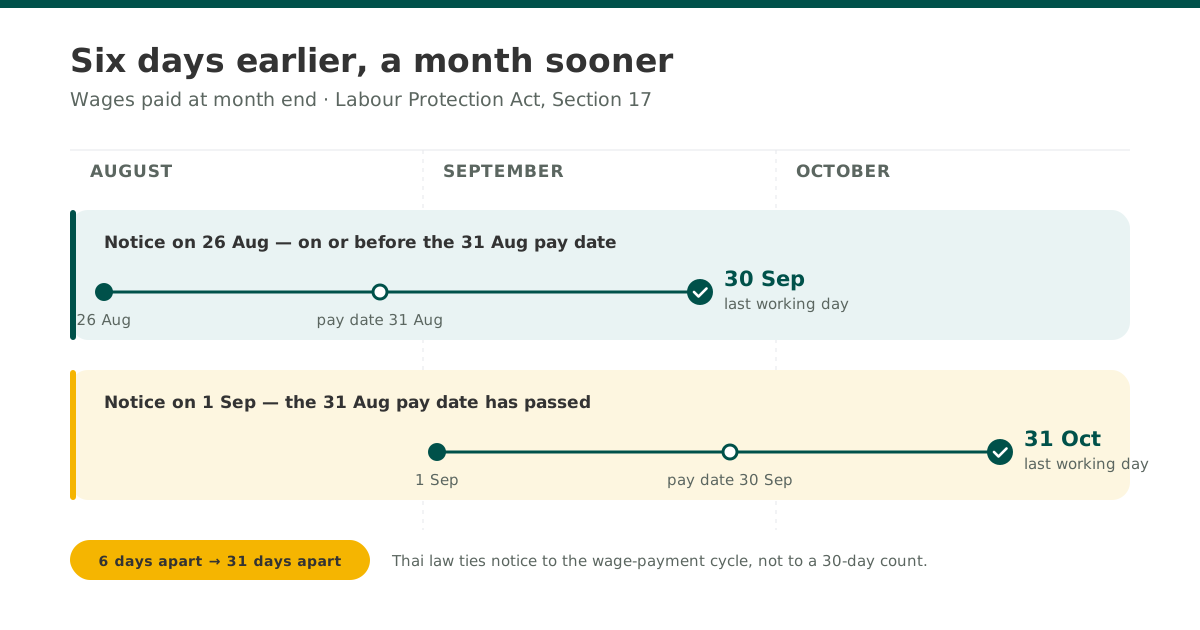
- Give notice on 27 January → you have missed the January payday, so notice takes effect at the next one after February's. Your employment ends 26 March — nearly two months.
One day of delay nearly doubled the notice period.
This is the single most useful thing to know before you hand in a letter: check your payday first, then choose your resignation date. If you are paid on the last working day of the month, giving notice on the 1st and giving notice on the 30th produce very different last days.
If you are paid twice monthly, the cycle is shorter and so is your statutory notice.
Can my contract require more than that?
Often, yes. Employment contracts in Thailand commonly specify 60 or 90 days, and Section 17's wording caps what the law requires rather than forbidding parties from agreeing to more. Employment lawyers generally treat longer contractual notice periods as enforceable.
There is a counterweight worth knowing about. Section 14/1 of the Labour Protection Act gives the Labour Court power to order that a contract term which gives the employer undue advantage over the employee is enforceable only so far as is fair and reasonable — the court trims the term rather than striking it out. Thai courts have used this to cut two-year and five-year non-compete clauses down to one year.
Whether that would be applied to an unusually long employee-side notice period is genuinely untested as far as published case law goes. So: assume your contractual notice binds you, but if you are facing something extreme like six months, it is worth a conversation with a Thai employment lawyer rather than assuming it is unchallengeable.
Read your contract before you assume the statutory minimum applies to you.
What happens if I resign without giving proper notice?
Four separate questions get tangled here. Taking them one at a time:
Can your employer refuse to accept your resignation? No. Resignation is a unilateral act — it takes effect on the date you state, and does not require the employer's approval. Thai Supreme Court authority is clear on this, and it goes further: if the employer tells you to leave earlier than your stated date, that is not a dismissal. It does not trigger severance or unfair-dismissal remedies; your claim is limited to wages up to the date you originally gave.
Can they withhold your final pay? No, and doing so may be a criminal offence. Section 76 sets out an exhaustive list of permitted deductions — tax, union dues, cooperative debts with consent, compensation for damage caused by wilful act or gross negligence with written consent, and provident fund contributions. "Did not give enough notice" is not on the list. Improper wage deductions can carry imprisonment of up to six months and fines up to THB 100,000.
Can they sue you for damages? In principle yes, under Section 582 of the Civil and Commercial Code — but they must prove actual loss, and in practice such claims are rare and are usually framed as the wages for the notice you did not serve. Lawyers describe these claims as "rarely enforced".
Can they withhold your employment certificate? No. Section 585 of the Civil and Commercial Code entitles you to a certificate stating the length and nature of your service, and the Department of Labour Protection and Welfare states explicitly that this applies whether you resigned or were dismissed.
So the honest answer is that leaving without notice is a breach of contract with limited practical consequences — but it burns the relationship with the employer whose HR team, if you are a foreign employee, still has to file your work permit cancellation correctly. That alone is usually reason enough to serve your notice.
Advertisement
Does probation change anything?
No — and this surprises people.
Thai law contains no statutory probation regime at all. There is no definition, no maximum length, and no special termination rule. Employers set probation periods entirely at their own discretion.
More importantly, the final sentence of Section 17 states that a probationary contract is deemed an indefinite-period contract. The ordinary wage-cycle notice rule therefore applies in full during probation, in both directions.
The 120-day figure you may have heard is unrelated to notice — it is the severance threshold in Section 118(1), which is why so many employers set probation at 119 days. It has nothing to do with how much notice you owe. There is more detail in the guide to resigning during probation.
What your employer still owes you
Resigning forfeits severance — that is only payable when the employer terminates — but it does not forfeit everything:
| Owed on resignation? | |
|---|---|
| Wages for days worked | Yes, always |
| Accrued unused annual leave | Yes (see caveat below) |
| Service certificate | Yes — CCC Section 585 |
| Vested provident fund entitlement | Per the fund's rules |
| Statutory severance | No — employer termination only |
| Payment in lieu of notice | No — that is an employer obligation |
On annual leave, Section 67 has two paragraphs since the 2008 amendment and they treat the two situations differently: pro-rated current-year leave when the employer terminates, and accumulated carried-forward leave when the employee resigns. Be aware that respected Thai and international firms state this differently from one another, so if a significant sum is at stake, check with the Department of Labour Protection and Welfare rather than relying on any single article — including this one.
On timing, the three-day deadline for final payment in Section 70 is worded as applying where the employer terminates the employee. Many practitioners apply the same standard to resignations. The safe expectation is your next scheduled payday at the latest. Late payment attracts statutory interest of 15% per annum, and a further surcharge where the employer withholds intentionally without reasonable cause.
▍Frequently Asked Questions
Is the notice period different for foreign employees?
No. The Labour Protection Act applies to employees in Thailand regardless of nationality. What differs for foreigners is everything that happens *after* your last day — your work permit and permission to stay end with the job.
Does my notice have to be in writing?
Section 17 refers to advance notice in writing. Give it in writing regardless: you want a dated record of exactly when notice was given, because that date determines your last working day.
My employer wants me to leave immediately. Do I still get paid for the notice period?
Section 17 allows the employer to pay wages up to the termination date specified in your notice and release you immediately. So yes — you should be paid to the date you stated, not to the day they sent you home.
What if my contract says 30 days but my payday means the cycle is longer?
Contract and statute interact case by case and this is exactly the kind of question worth taking to the Department of Labour Protection and Welfare, which answers public enquiries. In practice, agreeing a specific last working day in writing with your employer avoids the argument entirely.
Can I use annual leave as part of my notice period?
Only by agreement — there is no statutory right to do so. Ask early and get the answer in writing, because it changes your final pay calculation.
▍Read next
Tools: Letter Generator · Notice Calculator · After you resign
Advertisement