
Two Weeks' Notice vs Thai Labour Law: Why the American Rule Doesn't Apply Here
Two weeks' notice is an American custom with no legal force. In Thailand notice is set by statute and tied to your wage-payment cycle.
Two weeks' notice is a custom, not a law — and it is a custom from a country where employment is generally at-will. In Thailand, notice is set by statute: it runs from one wage-payment date to the next under Section 17 of the Labour Protection Act, which for monthly-paid employees is normally a month or more. Giving two weeks in Thailand is short notice.
If you have worked in the US and moved to Thailand, this is one of the easiest things to get wrong, because nothing about "two weeks" feels like a rule you are breaking.
Tool: Calculate your actual notice period under Thai law before you promise a start date to your next employer.
Source for the rule below: section 17 of the Labour Protection Act, with the parallel provision at section 582 of the Civil and Commercial Code. Thai text at the Legal Affairs Division, Department of Labour Protection and Welfare. Checked 4 September 2026.
Where two weeks came from
In most US states, employment is at-will: either side can end it at any time, for almost any reason, with no notice required at all. Because neither party owes notice, a norm evolved to fill the gap — two weeks became the polite amount, enough to hand over without dragging things out.
It is genuinely a courtesy. There is usually no statute behind it and no penalty for ignoring it. That is precisely why it travels badly: people carry the number abroad without realising it was never attached to any legal machinery.
Advertisement
What Thailand requires instead
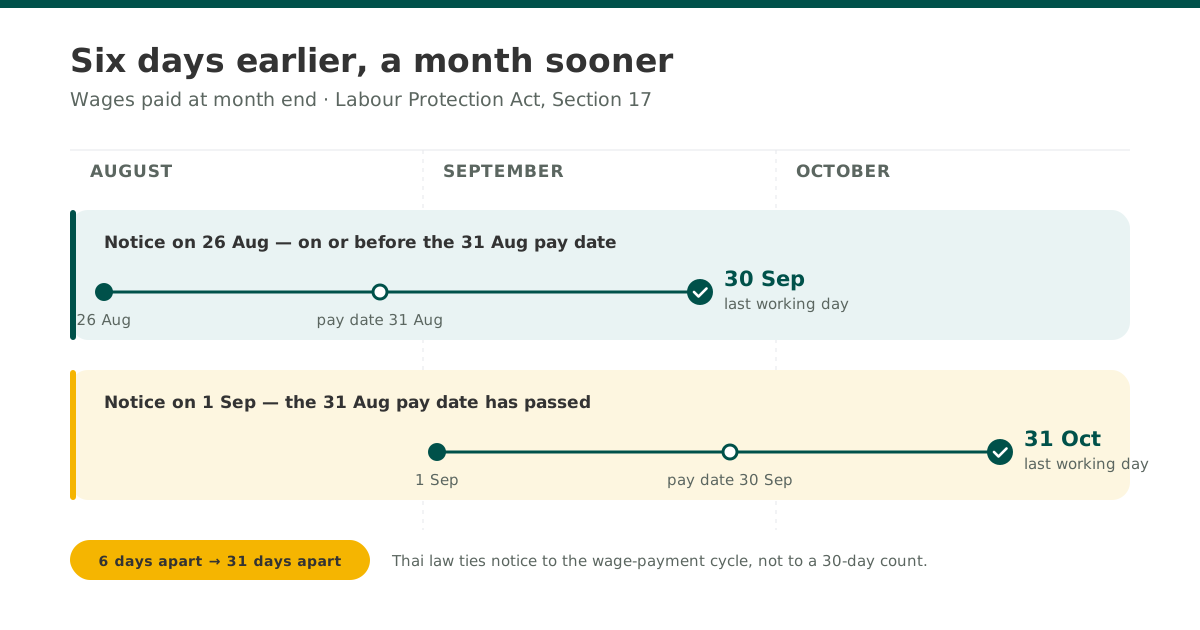
Thailand is not an at-will jurisdiction. Section 17 of the Labour Protection Act provides that for a contract with no fixed end date, either party may terminate by giving written notice at or before a wage-payment date, to take effect on the following wage-payment date, with no requirement to give more than three months.
The unit is your pay cycle, not a number of days.
For someone paid monthly on the 25th:
- Notice on 20 September → last day 25 October. Roughly five weeks.
- Notice on 26 September → last day 25 November. Nearly two months.
Two weeks does not appear anywhere in that arithmetic. There is a full explanation of how to count it in the Section 17 guide.
Side by side
| United States (typical) | Thailand | |
|---|---|---|
| Legal basis for notice | None — at-will employment | Labour Protection Act s.17 |
| Standard period | Two weeks by custom | One wage-payment cycle |
| Set by | Convention | Statute, plus contract if longer |
| Consequence of ignoring it | Reputational | Breach of contract; damages if loss is proven |
| Severance on resignation | None | None (severance is for employer termination only) |
The last row is the one both systems share, and it catches people out in the other direction: resigning in Thailand forfeits statutory severance completely, however long you have worked there. That entitlement — up to 400 days' wages at twenty years of service — only exists when the employer terminates you. See resignation versus dismissal.
What about UK, Australian and European notice?
Thailand's approach will feel more familiar to employees from these systems than the American one, but the mechanism is still different.
- UK — statutory minimum notice from an employee is one week after a month's service, with contracts almost always specifying more. The unit is weeks, counted from the day notice is given.
- Australia — statutory notice periods apply to employer termination; employee notice is usually contractual.
- Much of Europe — statutory notice scaled by length of service, often counted in months from a fixed point in the month.
Thailand's distinguishing feature is that the count is anchored to payday, not to the calendar or to length of service. That is what makes the "give notice before your payday" advice so much more consequential here than elsewhere.
Advertisement
Can I just agree two weeks with my manager?
Often, yes — and this is the practical answer most people need.
Nothing stops an employer and employee agreeing a shorter departure than the statute contemplates. Employers frequently agree, particularly when a handover is straightforward or the role is being restructured anyway.
What matters is that you get it in writing. An email from your manager confirming an agreed last working day protects you from a later argument that you left without proper notice. Without that, you are relying on memory and goodwill.
Do not simply announce two weeks and treat the matter as closed. Propose it, and ask for confirmation.
What if I give two weeks and my employer objects?
Realistically, the consequences are narrower than people fear:
- They cannot refuse the resignation. It is a unilateral act that takes effect on the date you give.
- They cannot withhold your final pay as a penalty — Section 76 lists the only permitted deductions and this is not among them.
- They cannot withhold your service certificate, which Section 585 of the Civil and Commercial Code entitles you to regardless of how you left.
- They can in principle claim damages for the un-served notice, but must prove actual loss. Such claims are uncommon.
The real cost is usually relational rather than legal — and for foreign employees it is more than relational, because that same employer has to file your work permit cancellation correctly and on time. That is a strong practical reason to leave on terms your employer agreed to.
The advice in one line
Find out your payday, count from there, and if you need to leave sooner, negotiate it and get the agreement in writing. Do not import a number from another country's customs and assume it applies.
▍Frequently Asked Questions
Is two weeks' notice illegal in Thailand?
Not illegal — it is simply less than the statutory notice, which makes it a breach of contract unless your employer agrees to it. Agreement makes it perfectly fine.
My contract says 30 days. Does the wage-cycle rule still apply?
Contracts commonly specify a period, and where they do, the contractual term generally governs — Thai employment lawyers treat longer contractual notice as enforceable. Read your contract first; the statute is the floor.
Do foreign employees have a different notice period in Thailand?
No. The Labour Protection Act applies regardless of nationality. What differs is the consequences after your last day, since your work permit and permission to stay are tied to the job.
Does two weeks' notice affect my unemployment benefit?
The Social Security unemployment benefit depends on the *reason* for leaving, not the notice given — 30% of wages for up to 90 days on voluntary resignation. How much notice you served does not change the rate.
What if I am still on probation?
Probation makes no difference to notice in Thailand. Section 17 expressly deems a probationary contract an indefinite contract, so the same wage-cycle rule applies.
▍Read next
Tools: Letter Generator · Notice Calculator · After you resign
Advertisement