
Resigning During Probation in Thailand: Notice and Pay
Thai law has no probation regime: Section 17 treats a probationary contract as indefinite, so the ordinary notice rule applies to you too.
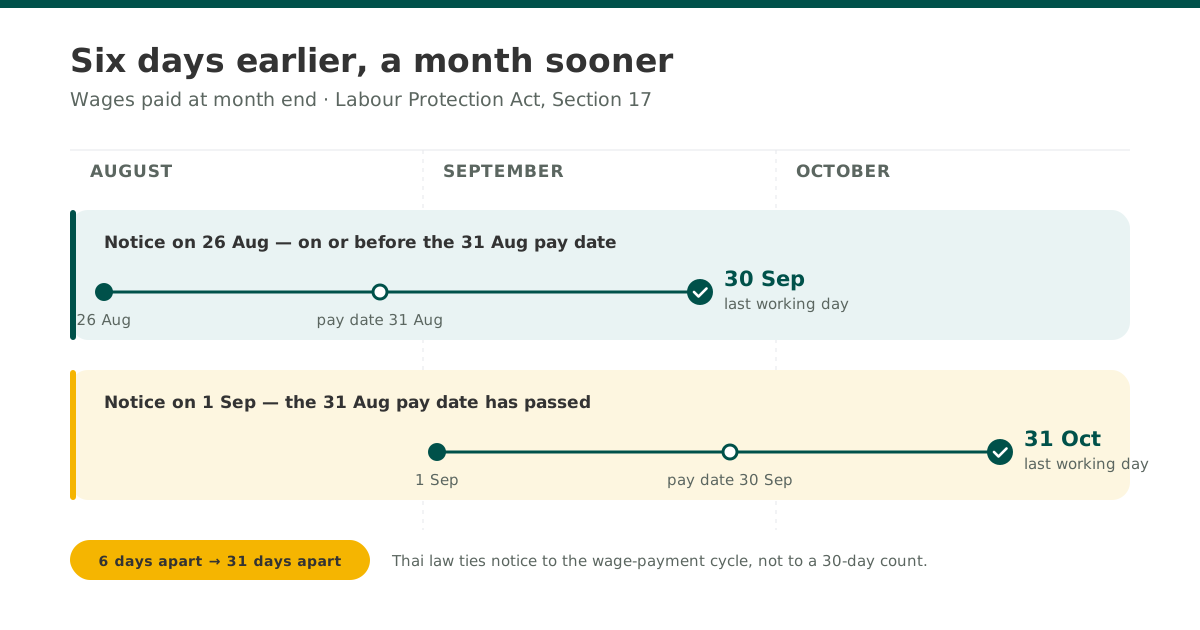
Thai law contains no special rules for resigning during probation. Section 17 of the Labour Protection Act expressly deems a probationary contract to be an indefinite-period contract, so the ordinary notice rule applies in full: notice given at or before a wage-payment date, taking effect on the next one.
That surprises most people, on both sides of the desk. Here is what actually applies.
There is no statutory probation period in Thailand
It is worth being precise about this, because the misunderstanding runs deep.
The Labour Protection Act does not define probation, does not set a maximum length, and does not create a lighter-touch termination route during it. Employers are not legally required to have a probation period at all, and where they do have one, they set the length entirely at their own discretion.
What the Act does say, in the final sentence of Section 17 paragraph two, is that a probationary contract is deemed an indefinite-period contract. Everything else follows from that.
So: same notice rule, in both directions. An employer dismissing a probationer owes the same wage-cycle notice or payment in lieu. A probationer resigning owes the same notice back.
Advertisement
Then where does "120 days" come from?
From severance, not probation — and the two get conflated constantly.
Section 118(1) sets 120 days of continuous service as the threshold at which statutory severance becomes payable on employer termination. Below 120 days, an employer dismissing someone owes no severance. At and above it, severance starts at 30 days' wages and rises with service, reaching 400 days at twenty years.
This is why so many Thai employers set probation at exactly 119 days. It is a severance calculation dressed up as a performance review period.
For someone resigning, the 120-day threshold is irrelevant. Severance is only ever payable when the employer terminates the employment — resign at 119 days or at nineteen years and you receive none either way. There is a fuller comparison in resignation versus dismissal.
How much notice do I actually owe?
The same as any other employee: check your payday, not the calendar.
Notice given on or before a wage-payment date takes effect on the following wage-payment date. Miss the payday by a day and your last working day moves a full cycle later. The Section 17 guide has worked examples.
Two things can change this in practice:
- Your contract may specify a shorter probation notice period — one week and two weeks are both common. Where the contract is more favourable to you than the statute, follow the contract.
- Your employer may simply agree to release you sooner. Probation departures are usually uncontroversial and employers rarely want to hold someone who has already decided. Ask, and get the agreed last day confirmed in writing.
What am I owed when I leave?
| Owed? | |
|---|---|
| Wages for days actually worked | Yes, always |
| Accrued unused annual leave | Depends — see below |
| Service certificate | Yes, whatever your tenure |
| Statutory severance | No — resignation never triggers it |
Wages are not negotiable. Section 76 of the Labour Protection Act sets out an exhaustive list of permitted deductions from pay, and "left during probation" is nowhere on it. Improper deductions can attract imprisonment of up to six months and fines up to THB 100,000. An employer telling you that probationers forfeit their final month is simply wrong.
Annual leave is the genuinely unsettled one. Under Section 30, statutory annual leave entitlement generally accrues after a year of continuous service, so a probationer may have little or no statutory entitlement to be paid out — though many employers grant leave from day one as a matter of policy, in which case the position depends on that policy. Respected law firms also state Section 67's treatment of leave on resignation differently from one another. If a meaningful sum is involved, ask the Department of Labour Protection and Welfare rather than accepting your employer's word or this article's.
The service certificate is yours by right under Section 585 of the Civil and Commercial Code — a statement of the length and nature of your service — regardless of how short the stint was or how you left.
Advertisement
If you are a foreign employee
Probation makes no difference to the immigration consequences, and this is where a short stint gets genuinely awkward.
Your work permit ends when the employment ends, and an extension of stay granted on the basis of that job ends with it. Your employer must notify the Department of Employment within 15 days. The permit is not transferable to a new employer outside BOI-to-BOI moves — the old one is cancelled and a new one issued.
The practical problem: if you resign five weeks into a job, you may have very little runway to arrange the next permit, and the discretionary seven-day extension stamp people rely on is a courtesy rather than an entitlement. Read what happens to your work permit when you resign before you hand in notice, not after.
Unemployment benefit after a short stint
Probably not available, and the reason is contributions rather than probation.
Social Security unemployment benefit requires contributions for at least six months within the fifteen months before unemployment. Someone who resigns two months into a first job in Thailand will not meet that. Someone who changed jobs and had years of prior contributions may well still qualify — the six months do not have to be with the employer you just left.
The voluntary-resignation rate is 30% of wages for up to 90 days, and you must register as unemployed within 30 days of leaving. Details in what you are entitled to after resigning.
How to explain it on your CV afterwards
This is the part people actually worry about, and it is more manageable than it feels.
Include it if it lasted more than a month or two. An unexplained gap invites more suspicion than a short role does.
Give a one-line, forward-looking reason. "The role turned out to be materially different from the one described at interview" is credible, common, and closes the topic. Interviewers hear it regularly and it is often true.
Do not criticise the employer. A short stint plus visible resentment reads as a pattern risk. A short stint plus a calm explanation reads as one of those things.
Have one specific detail ready. Vagueness is what makes interviewers probe. "I was hired to lead analytics and the role was reassigned to reporting support in the first month" answers the question completely.
If you left because of something serious — a safety issue, unpaid wages, harassment — you can say so briefly and factually. State what happened and what you did about it, without heat.
▍Frequently Asked Questions
Can my employer refuse to let me resign during probation?
No. Resignation is a unilateral act that takes effect on the date you state; it does not require acceptance. If they release you earlier than your stated date, Thai Supreme Court authority treats that as your resignation still, not a dismissal — so it does not entitle you to severance.
Do I need to give a reason for resigning during probation?
No. A resignation is valid without one, and a neutral single sentence is entirely sufficient if you want to offer something.
Will resigning during probation affect my work reference?
You are entitled to a service certificate stating the length and nature of your service under Section 585 regardless. Beyond that document, impressions vary by employer — which is the argument for serving your notice and handing over properly even on a short stint.
Is probation the same as a fixed-term contract?
No. A fixed-term contract expires on its stated date with no notice required. A probationary contract is deemed indefinite under Section 17 and needs notice from either side.
My contract says I can be dismissed during probation without notice. Is that valid?
That is inconsistent with Section 17, which requires notice in both directions during probation. A term that is unduly one-sided may also be reduced by the Labour Court under Section 14/1. If you are facing this, take it to the Department of Labour Protection and Welfare.
▍Read next
Tools: Letter Generator · Notice Calculator · After you resign
Advertisement